I attended the September 7th Ballrooms lecture with LaDonna Harris on "Global Indigeneity and Indigenous Value-Based Leadership in the 21st Century." I was very pumped for this lecture given my interest in Indigenous studies as well as my great respect and appreciation for Dr. Tahmahkera’s work. However, I found myself actually coming away with more from Dr. Tahm’s introduction of Ms. Harris than from her actual lecture.
Her lecture was co-sponsored by nearly every department and its brother – apparently everyone wanted in on this rarer of the minorities action. Ms. Harris herself is a Comanche activist and stateswoman with the organization (she founded) called Americans for Indian Opportunity. She’s an older woman and beautiful, and she had a wonderful way of speaking and storytelling. However, it ended up being more story than informational substance within her lecture. There’s was a great deal of discussion about her family and personal experiences – which is cool, I have no problem with that, but I was expecting a much more detailed discussion about her activist organization’s history, it’s current work, and how we could potentially get involved.
She did discuss some of the issues with the “browning” of America and “how we have to change our literatures to be inclusive of others.” – a quote I actually found very cool given my thesis which also discusses the necessity of better including both Native American and Beat literatures within the general American literary canon (as it is taught within schools private and public) in order to improve general inclusiveness of both cultures. She had another good quote-moment: “I don’t have all the answers but I have some ideas.”
And while I greatly appreciated that sentiment, as I mentioned, I also found myself frustrated by the fact that she didn’t mention any ways for us – the bulk of “us,” her audience, being white and relatively wealthy – to get involved with helping bring those ideas into fruition. Also, I took a friend with me who posed some interesting questions about the lecture material and who discussed with me the issue facing most of us well-intentioned non-Natives:
How are we supposed to help without becoming a detrimental or assimilating force?
Some other poor kid managed to choke out something like this question before I could but even then her answer was less than satisfactory. I believe it had something to do with us finding and nurturing our medicine. And I do understand and appreciate the sentiment because if everyone continued to nurture their education throughout the entirety of their lives then perhaps we’d have a much more peaceful and tolerant world, but I just wanted wanted wanted something concrete.
I suppose, though, concrete is too easy – if there was a concrete answer or way, after all, I’m sure these sorts of prejudices and ignorance would no longer be such a plague and problem for our globalizing societies. But the problem of how to get further involved with the Indigenous cause without becoming a detrimental force or overstepping my boundaries continues to haunt me.
I just read this poem by Sherman Alexie (a Spokane author/screenwriter/filmmaker) from his collection “War Dances” entitled, “Go, Ghost, Go,” and though it’s probably illegal for me to post it up here I’ll just give a little snippit of the ending since it’s just so piquant and has spoken to me so cleanly:
(he’s discussing how strange it is for a white professor to speak so excitedly or agreeably about the Ghost Dance which is a dance that would, if performed properly, send all white men to hell and resurrect all Indians)
“I think that he thinks he’s the new Jesus.
He’s eager to get on that cross
And pay the ultimate cost
Because he’s addicted to the indigenous.”
As hard as it may have been (and continues to be) to think on the vagueness of Ms. Harris’s lecture and advice, perhaps it’s me who needs to reevaluate what exactly it is that I’m hoping to achieve or accomplish. Perhaps I simply need to narrow down my focus – that does seem to be the reoccurring issue within my statement of purpose for graduate school – I just want to do too many things and become a greater force than I am.
Monday, September 20, 2010

Sunday, August 29, 2010
addenda!
What if we also were able to get a change made to the course evaluations asking students if professors or how professors connected to a larger liberal arts idea(l)?
Saturday, August 28, 2010
Paideia 2010/2011 -- Senior Year
First of all... WELCOME BACK It's so wonderful to be back and learning with you all, my dear friends.
Well, I think I might like a weird goal for Paideia this semester to be to spur a social movement on campus – perhaps it’s a small one, a local one, but I’d like to try and brainstorm ways to make both Paideia and the campus as a whole a more efficient and true liberal arts environment. In all my years here, I’ve had count ‘em ONE professor ask me how their coursework interacted with what I was learning in my other classes. I believe this is fundamentally wrong for teachers at a professed liberal arts institution. People need to get out of the mindset that they are teaching in or majoring in a single department & remember that everything is interrelated and that by looking at this wider scope we may discover ways of truly and meaningfully changing social systems in the future.
I’m learning about a lot of this ahora in my Rhetorics of Resistance and Principles of Economics classes (Econ being the ONE class to try and reach out to my other classes) and I truly believe that this is something we as Paideia students should’ve been required to do from the beginning. I know this is a tres ambitious goal but I think it may also be a doable one – at least a Begin-able one – and one for which we are all uniquely apt candidates to strive for given that we are seniors and would (hopefully) be pissing off all the students and professors EXCEPT those writing our letters of recommendation :p I mean, what would it take? Some petitions, some advertising, a facebook group, a couple tables in the Commons, maybe a speech in the Cove instead of a concert series, some letters to the Admins up top, some rogue professor support, and all for professors to just ask the question:
“How does this tie in with what you’re learning in your other classes?”
And maybe even assign a short paper or two per semester about how the material is related or may be influenced or apt for some other coursework in another class – I haven’t had a single problem doing this on my own time with classes as putatively distant as Exploring the Universe and Shakespeare Topics to classes as already clearly linked as Principles of Economics and Urban History. This would force students to think more completely and liberally about what they’re learning and thus would help them better appreciate all fields and knowledge, AN APPRECIATION FOR LEARNING ITSELF, and would force professors to return to working and better communicating with each other – maybe even create interdisciplinary projects together one day – and thus break up this anti-liberal segmentation that’s so easy and become so popular.
What do you all think?
I think this could also double as our civic engagement project.
As to my Intercultural Experience – that’s what my previous five or six blogs has been about. I went this summer first to South Carolina for a family vacation/mini reunion, then to Monterey, CA in order to present my Honor Thesis (which is also my Creative Works Research Project for Paideia (as well as for my American Studies Capstone)) (and it went amazingly beautifully wonderfully, by the way), and then I flew directly from CA to NYC in order to study Comparative Ethnic Urbanisms with NYU. It was a terrifying and sobering experience which has led me to better narrow my goals for my graduate study which now reach to study history as a webbed entity using literary works as focal points and from their work both as a constant volunteer and author in social activism to aid in environmental causes as well as in aiding in the end of educational inequality. I was dropped in a class of 8 people from different cities and countries to study together the urban enclaves of Indians, Chinese, Vietnamese, Latinos (Salvadorian, Mexican, Dominican, etc), and Arab peoples – not to mention the variety of cultural parades I ended up walking into from the Gay Pride Parade to the Pakistan Independence Parade. It was a wild ride that has spurred in me a greater need to dedicate my wonderful education and career goals to social activism – it has also spurred in me a great dislike of NYC as a city of sad people in a wreaking environment that just happens to house some of the most magnificent museums on the planet.
As for my Creative Works Honor Thesis:
I am very proud to tell you all that by graduation this spring, I may have an official book deal/contract with McFarland & Company, Inc., Publishers. I turned in a proposal of my Honor Thesis to them & they really dig it & so now we’re have contractual discussions :D Of course, they want an expanded version of my (so far) 96page thesis, so my actual Paideia/Capstone project will remain focused upon specifically Ginsberg’s “Howl” and the influences of Native American trickster mythology within it but the separate expanded versions it will also discuss up to seven other poems as well as broader protest and social movement affects, implications, ect. I’ve already, as aforementioned, finished the rough draft so now I’m dedicating this semester and next semester to editorial work. I’ve also, as aforementioned, already presented on this project, but I’m hoping to also have the time to present it at next semester’s Student Works Symposium.
I’m so excited! :D
until Tuesday…
Tuesday, August 3, 2010
Sunset Park, Brooklyn
Well, yesterday was très intéressant. Après la classe, I went to dinner with my Prof Ariana (she’s still working on her doctorate – doesn’t seem very excited about it though (or the class for that matter – I can’t wait to be excited about graduate studies; what a shame to put all that work into something that doesn’t remain joyful, but anyhoo) – and we took the subway out to where the tour was in Brooklyn to eat at this El Salvadorian restaurant called El Continental Restaurant: Sirviendo Comidas; Salvadoreñas & Hispana. It was excellent & exciting because I’ve never had El Salvadorian food before so she had me try the pupusas (which were excellent), these corn pastries layered with some pork, beans, and cheese & then I also tried some cebada to drink which is this pink drink (they served with milk) that’s made from pink flowers (very sweet but refreshing, like a cold tea, almost). It was interesting getting to spend those couple hours just with her and talking with her about her graduate experience and teaching and her work on immigration and Latino studies (though, like I said, she’s hardly the most jacked up sort, to which I have a difficult time understanding).
But after dinner the fun truly began – we caught the bus tour with a community development/environmental justice/revitalization group called UPROSE. It was founded in 1964 and “is Brooklyn’s oldest Latino community-based organization” (quoting their mission statement/history hand-out). Sunset Park is a community built up against one of Brooklyn’s piers with an astonishing panoramic view of Manhattan, Liberty Island, and Staten Island – but you’d never know about that because their pier might as well be condemned. It’s directly across from a brown field (a toxic/contaminated area unfit for recreation) and the pier area has been paved for a parking lot and disallows fishing, barbequing, and basically all other community recreational activities imaginable (especially since the police apparently have a troubling proclivity for stopping and randomly searching anyone who decides to indulge in some sort of public recreation whether it be walking or playing basketball). There are signs up which warn against fishing given the extreme contamination of the water but the community population is built of Arabs, Asians, and Latinos (many of which if not most cannot read English), so what good do warning signs in English do for them? This is a dangerous trend that runs through most of their community’s “safety precautions.”
Pier at Sunset Park:

Also, they are home to a Natural Gas plant which equals plenty of pollutants such as Particulate Matter 2.5 which you may breathe in but, unlike other pollutants, you do not breathe or sneeze out – it remains in your lungs and in your brain which causes all sorts of health issues. The majority of Sunset Park’s population, because of pollutants like this and like the exhaust from the above-ground expressway and from the waste hauling trucks and tractors (which tow the waste through neighborhoods since there is no other way to move onto the expressway (which goes directly over some of the neighborhoods anyway)), suffers from asthma. They actually just recently had a person die from an asthma attack there, which many people today, given modern medicine, consider nearly impossible – but most of these people either consider asthma normal or don’t have the money to medicate their condition and so either end up just trying to deal with it or spending thousands of dollars in hospital bills. The canal which runs through the neighborhood has been determined a “super-fund site,” which basically means that it’s so incredibly contaminated and hazardous that funds have been pulled from various major corporations to forcibly clean up some of the contamination (although how quickly or efficiently this is enacted is yet to be seen).
Of course, if you drive just a couple blocks outside of Sunset Park and into Bay Ridge, you’ll encounter a difference so stifling you’ll feel as though you stepped into a Michael Moore film – surely, it can’t be true; the drama is too much.
Just a couple blocks into Bay Ridge, a highly gentrified and much whiter neighborhood, is covered in trees. Everywhere you look is green, green, green. And a step onto their pier reveals crowds of children eating hotdogs and ice cream and middle aged men fishing together with a large sign advertising their water pollution control efforts. A complete shift from the deserted and deadened pier of Sunset Park or its treeless streets. And, I have to say, it beat up my heart to think about the actual systematic racism and environmental racism at hand here in these neighborhoods. We learned about the community charter efforts to create their own effective 197A Plans to revitalize Sunset Park which are continuously trumped and stopped by the greater regional City Planning group which allocates funds and has the general upper-hand in the planning and policy of many Brooklyn communities. This regional racism keeps the obviously minority and lower-income communities (such as Sunset Park) at a huge disadvantage environmentally and economically when compared to other whiter neighborhoods (such as Bay Ridge).
Pier at Bay Ridge (sorry for the poor quality -- these were taken on my cellphone :p):
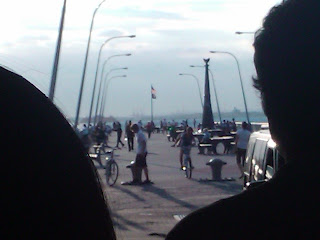
One of the big campaigns UPROSE has been recently working on is planting trees in neighborhoods to help function as buffers against some of the pollution – the problem is that many people don’t want to sign the petitions to fight for trees because those trees, though they would raise the equity of their homes and help with pollution control, would also raise their rents beyond what they can afford; essentially, even the basic necessity and pleasure of a tree in the front yard is denied them because it would automatically displace the bulk of the community to simply another, possibly worse, treeless neighborhood.
And the more blatantly gentrifying forces are already moving into town with, albeit currently vacant, million dollar condos and the like.
It really does feel hopeless in many ways. However, as we drove through their streets and through their Chinatown (the second largest in NY), and we saw all the different languages and all the different peoples milling about together (everyone from Vietnamese to Malaysian to Salvadorian to Mandarin and so on), it occurred to me that what if all it took was an advertising campaign to run alongside the tree-planting campaign. There are plenty of ethnic restaurants and shops I’m excited to go and explore and which I know many of my friends (both here and at home) would also be excited to explore – so why not go ahead and improve neighborhoods, which would raise rents, but then push outside consumerism of these local businesses (and keep out major chains like Chili’s or Starbucks) and in this way also potentially raise wages to help match these increased costs? I know there are many market forces I’m not taking into account, but I’m just wondering if something like this has been implemented anywhere else and if it’s a viable possibility.
UPROSE Tour Bus (the large dude facing away was our tour guide):

I know many people are against this sort of thing because they view the commodification of culture as detrimental to those cultures – but I find that inherently backward because all things are subjective and affected by us simply by us being aware of them; in other words, these cultures are already commodified by the inherent nature of stores and shops and communities, so what’s wrong with outsiders coming in and enjoying them? – especially if it helps keep those businesses in business. It’s something I’m still thinking about, but wouldn’t it be amazing to get to be a part of a campaign like this one day? It’s expensive, obviously, which is probably why it hasn’t been done yet (along with a slew of other reasons) but I just can’t think of any other way to better these communities from within and without while simultaneously staving off displacement. After all, capitalism necessitates economic disparity, there’s no two ways around that – no matter how hard we work, there will be those richer and poorer always, but this is simply a matter of human decency. No one deserves to live in such a hazardous environment and especially not for reasons so evil as racism.
But after dinner the fun truly began – we caught the bus tour with a community development/environmental justice/revitalization group called UPROSE. It was founded in 1964 and “is Brooklyn’s oldest Latino community-based organization” (quoting their mission statement/history hand-out). Sunset Park is a community built up against one of Brooklyn’s piers with an astonishing panoramic view of Manhattan, Liberty Island, and Staten Island – but you’d never know about that because their pier might as well be condemned. It’s directly across from a brown field (a toxic/contaminated area unfit for recreation) and the pier area has been paved for a parking lot and disallows fishing, barbequing, and basically all other community recreational activities imaginable (especially since the police apparently have a troubling proclivity for stopping and randomly searching anyone who decides to indulge in some sort of public recreation whether it be walking or playing basketball). There are signs up which warn against fishing given the extreme contamination of the water but the community population is built of Arabs, Asians, and Latinos (many of which if not most cannot read English), so what good do warning signs in English do for them? This is a dangerous trend that runs through most of their community’s “safety precautions.”
Pier at Sunset Park:

Also, they are home to a Natural Gas plant which equals plenty of pollutants such as Particulate Matter 2.5 which you may breathe in but, unlike other pollutants, you do not breathe or sneeze out – it remains in your lungs and in your brain which causes all sorts of health issues. The majority of Sunset Park’s population, because of pollutants like this and like the exhaust from the above-ground expressway and from the waste hauling trucks and tractors (which tow the waste through neighborhoods since there is no other way to move onto the expressway (which goes directly over some of the neighborhoods anyway)), suffers from asthma. They actually just recently had a person die from an asthma attack there, which many people today, given modern medicine, consider nearly impossible – but most of these people either consider asthma normal or don’t have the money to medicate their condition and so either end up just trying to deal with it or spending thousands of dollars in hospital bills. The canal which runs through the neighborhood has been determined a “super-fund site,” which basically means that it’s so incredibly contaminated and hazardous that funds have been pulled from various major corporations to forcibly clean up some of the contamination (although how quickly or efficiently this is enacted is yet to be seen).
Of course, if you drive just a couple blocks outside of Sunset Park and into Bay Ridge, you’ll encounter a difference so stifling you’ll feel as though you stepped into a Michael Moore film – surely, it can’t be true; the drama is too much.
Just a couple blocks into Bay Ridge, a highly gentrified and much whiter neighborhood, is covered in trees. Everywhere you look is green, green, green. And a step onto their pier reveals crowds of children eating hotdogs and ice cream and middle aged men fishing together with a large sign advertising their water pollution control efforts. A complete shift from the deserted and deadened pier of Sunset Park or its treeless streets. And, I have to say, it beat up my heart to think about the actual systematic racism and environmental racism at hand here in these neighborhoods. We learned about the community charter efforts to create their own effective 197A Plans to revitalize Sunset Park which are continuously trumped and stopped by the greater regional City Planning group which allocates funds and has the general upper-hand in the planning and policy of many Brooklyn communities. This regional racism keeps the obviously minority and lower-income communities (such as Sunset Park) at a huge disadvantage environmentally and economically when compared to other whiter neighborhoods (such as Bay Ridge).
Pier at Bay Ridge (sorry for the poor quality -- these were taken on my cellphone :p):

One of the big campaigns UPROSE has been recently working on is planting trees in neighborhoods to help function as buffers against some of the pollution – the problem is that many people don’t want to sign the petitions to fight for trees because those trees, though they would raise the equity of their homes and help with pollution control, would also raise their rents beyond what they can afford; essentially, even the basic necessity and pleasure of a tree in the front yard is denied them because it would automatically displace the bulk of the community to simply another, possibly worse, treeless neighborhood.
And the more blatantly gentrifying forces are already moving into town with, albeit currently vacant, million dollar condos and the like.
It really does feel hopeless in many ways. However, as we drove through their streets and through their Chinatown (the second largest in NY), and we saw all the different languages and all the different peoples milling about together (everyone from Vietnamese to Malaysian to Salvadorian to Mandarin and so on), it occurred to me that what if all it took was an advertising campaign to run alongside the tree-planting campaign. There are plenty of ethnic restaurants and shops I’m excited to go and explore and which I know many of my friends (both here and at home) would also be excited to explore – so why not go ahead and improve neighborhoods, which would raise rents, but then push outside consumerism of these local businesses (and keep out major chains like Chili’s or Starbucks) and in this way also potentially raise wages to help match these increased costs? I know there are many market forces I’m not taking into account, but I’m just wondering if something like this has been implemented anywhere else and if it’s a viable possibility.
UPROSE Tour Bus (the large dude facing away was our tour guide):

I know many people are against this sort of thing because they view the commodification of culture as detrimental to those cultures – but I find that inherently backward because all things are subjective and affected by us simply by us being aware of them; in other words, these cultures are already commodified by the inherent nature of stores and shops and communities, so what’s wrong with outsiders coming in and enjoying them? – especially if it helps keep those businesses in business. It’s something I’m still thinking about, but wouldn’t it be amazing to get to be a part of a campaign like this one day? It’s expensive, obviously, which is probably why it hasn’t been done yet (along with a slew of other reasons) but I just can’t think of any other way to better these communities from within and without while simultaneously staving off displacement. After all, capitalism necessitates economic disparity, there’s no two ways around that – no matter how hard we work, there will be those richer and poorer always, but this is simply a matter of human decency. No one deserves to live in such a hazardous environment and especially not for reasons so evil as racism.
Sunday, August 1, 2010
Last Few Days
Well, I was leaving my GRE practice test on Madison & 42nd street and walked straight out into the Pakistan Independence Day parade. It seemed wonderfully cyclical for this to happen in my last week given that the very first day I came to NYC when I got horribly lost and caught up in a Gay Rights parade. The interesting thing about NYC is that it functions as a highly stimulated microcosm of the intercultural nature of all of America. From Gay Rights to Pakistan Independence (and bless poor Pakistan for all the beatings they’ve taken this summer from floods to crashes to simply being in Pakistan), New York makes it impossible to not have an intercultural experience.

However, I truly feel, as someone who has already traveled abroad to Mexico and the UK with parents who’ve been even farther, as someone who can hardly call a night in a gay bar as an intercultural experience and who already enjoys exploring any new restaurant or food or neighborhood I can without qualms or shyness about striking up a conversation with the clerk or the waitress – just today, I tried out this new Indian spice shop called “Spice Corner & Halal Meat,” and just for asking the clerk how his day was going he kept giving me free Indian candies and cookies to try out (it was phenomenal!) – I find it problematic to simply say that my experiences here in NYC (outside of my class work) were somehow more or less intercultural than many of the experiences I’ve had in London or Edinburgh or Dallas or Austin or Monterey or San Antonio or Juarez, Mexico – simply the cultural differences between Texas and New York have been staggering and it has all made me realize just how intercultural America is as a whole and that just speaking with my classmates has taught me more about how to handle and humble myself in the face of other cultures and cultural norms than I ever anticipated. A person could rule this city simply by being polite. I can’t list you all the times I’ve had people thank me or ask where I was from or offer me free things simply for inquiring after their days or for thanking them, talking with them. Also, the pace change is absolutely monstrous. I know I typed a bit about this in a previous blog entry but it really was a relief to hear someone else say what I’d been hoping and wondering and suffering:
The Culture of Rush, of always having to be doing something, is a destructive cycle that is socially reproduced by all New Yorkers – a pressure that if you aren’t constantly moving or checking your watch or doing something or out and about then clearly you are wasting your time and should feel friendless and lonely and pitiable for so sadly pissing away your time.
And having always lived in the South, I suppose, and in the suburbs from the suburbs of Durham in North Carolina to Kentucky to Texas, and with my much more laid back parents and the casualness of SU – I was thoroughly unprepared for this change, even with all of my time spent in Austin or Dallas or London – it very much has struck home to me that urban culture is something that must be lived in order to be felt or understood. It has also struck home to me how and why urban environments seem (and usually are) inherently more intercultural than suburban areas. This is really what my entire course has been over, I suppose. Understanding why cultural enclaves exist within urban centers and why the suburbs remain largely white – and it’s all to do with entrapment, redlining, block busting, inherited wealth or inherited poverty, transportation issues, environmental racism, and – a term I actually came up with myself – ecological redlining (along with a whole score of other systematic prejudices). And in this way, I’ve learned, that my urban experience and my intercultural experiences are really inextricably interrelated.
Tomorrow after class I have a meeting with a literary agent (I can’t wait!!) and then we’re going on a class field trip through some parks and neighborhoods – the details aren’t clear yet, but I’ll absolutely be posting about what happens there – and I’m also planning, at some point, to visit a sex shop because, as Dr. G has pointed out to our Paideia cohort before as well as to her Human Sexuality classes, that can be an intercultural experience all on its own. And, to be honest, I’ve never been in one before because it makes me uncomfortable. So, we’ll see what happens.
Saturday, July 31, 2010
Flushing, Queens
It was a very strange (and surprisingly comfortable) sensation to realize I was the only white person in our group. Five of us decided we’d journey out into Flushing, Queens (it took about an hour by subway to get there), instead of going to the thickly commercialized Chinatown for some Malaysian food. The Five: myself (white), Jasmine (Japanese), Sye Yuet (Singaporean), Rebecca (part Hawaiian, part Korean), and I Forgot Her Name Friend of Becca’s (Indian). So we all met at Astor Place and subwayed to Flushing – and I watched from stop to stop as slowly the white passengers filtered out (the last of them having only waded out so far into Queens in order to get to JFK airport) and Then There Was One. But I have to say, even though all the girls in my groups were of varying backgrounds, culturally we were all in sync so there was no discomfort or real change at all (besides them being very interested in all the differences between NY and TX).
It really didn’t strike home for me that I was a sincere minority until we got off the train and stepped into the world of Chinese billboards, Chinese crowds, people who could look at me in a restaurant and know I was different, know I didn’t live there, didn’t “belong” there – and I suppose that was the most troubling of the feelings (which I was able to deal with since being with friends) but knowing that people saw me come in and shrugged me away as someone who would be leaving shortly because clearly I didn’t belong with them, clearly I couldn’t be living there, and perhaps, clearly I shouldn’t be living there. I’m not saying I experienced racism or anything like that, simply that I experienced, I think for the first time, being considered Different or Out of Place.
The food was delicious! We went to a place Sye Yuet picked (because we all wanted something as “authentically” Chinese as possible) called Malay Restaurant Inc., and it was beyond fortunate that we had her because she’s the only one among us who can speak and understand Chinese (which is pretty much how you ordered food at all unless you just pointed about). But she knew how many of the foods were cooked and what tasted like truer Singaporean, Malaysian, etc., and so we decided to do a family-style try-all. We ordered (or Sye Yuet ordered for us in Chinese (I included a photo of some of the food)) a Buddhist Yam Pot (delicious but too rich for me, just a few bites and I felt dizzy), Barbecued Fish-Skate, Satay, Hainanese Chicken Rice, Sambal Squid, and what I believe was Spicy Thai Chicken. And I learned about (though sadly didn’t get to try this time around) Durian Red Bean Ice: durian is, apparently, a South Asian fruit that smells so strongly (and badly) that it can take a long time to get used to and even cause illness or fainting but if you just go ahead and taste it’s apparently delectably sweet and addictively good.

(The photo shows the yam pot, one of the remaining satays, some teacups, peanut sauce, and the sambal squid. (Oh, and I don’t think we ordered tea, it was simply brought out and served, sort of like water in other restaurants.))
But there wasn’t a single dish served that I’d ever tried before, which was exciting, and complimentary watermelon slices were served at the end (the same way mints usually are in the restaurants I’m accustomed to). And during the meal (which did take a while – it was five girls’ worth of conversation), we mostly (I’m proud and impressed to say) discussed our separate cultural backgrounds and the shifts between them, from the strangeness of “common sushi” in America versus the sushi-as-luxury food in Japan and what this switch means for American perceptions of Japan to discussing the pace difference (which I have absolutely been victimized by) between Texas and NYC and the cultural stress to rush and be busy that seems ubiquitous here to discussing the street culture and foods of Vietnam to, of course, discussing Singapore. But these are truly Women of the World – Friend of Rebecca had just gotten back from travels from London to Rome to Madrid and back, while Jasmine had been all over Asia (along with Rebecca and Sye Yeut), and Sye Yuet who is going to be going back to Singapore for a couple weeks before going back to school in London. In other words, the discussion was wonderfully colorful and intelligent and brave and now I’m excited and eager for the day when I get to curlicue my way through Asia and then into Italy and deeper into Europe – I have decided that this trip and these people have proven to me I do harbor a love for traveling and for learning by experience, but that I also need this tempered with company and a break at home. And perhaps the reason I have had a more difficult time assimilating into NYC is because I’ve spent most of the summer away from home and others from school to Carolina to California to NYC without much of any stoppage in between.
After dinner we journeyed through a sea of Asian characters and advertisements and neon signs to a tea café for dessert (I believe it was called Sago “Something”) and then to a little bakery for breakfast and/or gifts. This little place, just a slice dug out of the strip, was called Maxin Café. It was difficult making any decisions on what to buy there since only some of the food names were translated on their price stickers (fortunately, again, we had Sye Yuet). I ended up just grabbing a tin of coconut cookies for my Nana but they had all sorts of sweet flatbreads, fruit cakes, green tea cakes, sesame breads, red bean pastries, etc.
We acted particularly tourist-esque thanks to the bravery of Rebecca who took no qualms with asking anyone from waiters to people on the street to act as our photographer and, I have to say, this made me realize a strange sort of a preconception in myself as I found it to be an almost role-reversal to have Asian people taking tourist photographs of me instead of the other way around. And, while this seems to me as a relatively harmless race generalization, it bothered me just realizing that I’d had this generalization engrained within me in the first place. It was also strange to realize that I was, effectively, a cultural (and racial) tourist in my own country. What a new and oddly fitting feeling to realize that I wasn’t being a tourist by taking a photo of a mountain or statue but of myself in comparison with the culture and people around me – as if they were a mountain or a statue.
And I guess this is when I realized just how aware I’ve constantly been of my race in this state versus how little I think about it while I’m at home. Every time I’ve walked down the street, I’ve made notes to myself on whether or not I was the only white person walking down. Every time I’ve heard a different language buzz by on a cell phone, I’ve wondered about my own validity as an American and why whiteness should seem to qualify me so well (the Arizona fuck-up, knowing I wouldn’t be stopped and questioned simply because I’m white).
It’s…strange.
ciao for now!
katie
Wednesday, July 21, 2010
Week 3/4 of NYC
Howdy again from NYC – good and bad, delicious and bitter, my padre came by on his way to Vermont for a gallery ceremony where some of his photography was displayed, and then Evan came up for our 10 month anniversary with the surprise of Bernadette Peters in “A Little Night Music” (and we totally got to see her naked (I don’t think the mirror was supposed to be placed that way)) and all in all it made for a wonderful and much more adventurous past handful of days, but now I’m sadly in withdrawal again. I’ll cope, I know, but I’m still counting down the days until I get to be home and then at SU again.
I’ve now managed to navigate my way around through Central Park, the American Museum of Natural History (the Hall of Origins is breathtaking), and the Metropolitan Museum (Picasso is something…special). I’ve also been spending a good deal of time in Little India, tried some Turkish food, some Turkish coffee (stronger than espresso, thick and gritty, delicious but it made my hands shake), and tried generally to reconsider the neighborhood through the scope of my current coursework: cultural assimilation, residential segregation, environmental racism, etc. I haven’t noticed much thus far in Little India by way of environmental racism, but the first two issues are absolutely prevalent. The restaurants may be Indian, the owners and cooks may be American Indian, but the styles of things seem to be assimilating into the general “Americana” culture. I stepped out of my Turkish joint to find across the street a place literally called “Curry in a Hurry”. And while the Turkish place is called Ay Kitchen, which is also, arguably, by virtue of its English alone, culturally assimilated, it didn’t seem to advertise itself or its food to the stereotypical busy white New Yorker the same way that “Curry in a Hurry” seemed to do.
It was also interesting to notice that the places seeming most frequented by the neighborhood Indian population were basement restaurants that I barely realized were restaurants at first, so well tucked under as they were. This reminded me of, though not quite so blatantly, the Mexican restaurants back home with signs up in the windows that say: No English – apparently meaning that they don’t speak English, coded meaning that they don’t intend to serve white English speakers, coded meaning that they serve “actual” Mexican food.
I would also say that New York seems to be one of the most unashamed examples of rampant residential segregation since the very existence of a cultural enclave such as Little India (or Chinatown or Little Italy) functions as a form of residential segregation. Especially since, though there were other non-Indian people eating and passing through, it’s definitely apparent that they aren’t living in the neighborhood as the American Indians working there are. This begs the question of why – why is it that the capitalist class may commodify cultures (as well as their own) and in doing so force people into ghettos or slums or cultural enclaves in order to preserve traditions? It’s also interesting to see how parts of town become encoded as either good or bad, safe or dirty, because I was actually surprised to find Little India in the part of town (upper part of Gramercy and lower part of Murray Hill) I did. The quality of streets seems to change at random, moving from the “nice” and more predominantly Jewish part of town that I’m staying in (surrounded by Baruch College and Yeshiva University) to the less reputable (not necessarily a “bad” part of town, but definitely a shift) into the predominantly Indian and noticeably poorer neighborhood.
I’m now excited to go with Sye Yuet (my classmate from Singapore and university in London) to Chinatown seeing as she can speak Chinese and thus, I’m hoping, will be able to give us access to the figurative basement or “No English” type of experience. However, I have to say, that I’m really finding it easier to recognize and appreciate the diversity and intercultural aspects of my classmates than of my pioneering into these various enclaves. These enclaves seem to have cookie cut themselves out in order to cater to and mask their cultural origins from the typical white capitalist class patrons, whereas my classmates (Jasmine (Japanese): Tokyo, Sye Yuet (Singaporean): Singapore/London, Chris (white): Pittsburgh (I’m pretty sure), Palik (Indian): Chicago, Todd (white): NY, Rebecca (Hawaiian, I believe): Hawaii, Prof Ariana (Hispanic): NY (parents, I’m pretty sure, from the Dominican Republic), and Moi (white): NC/TX ) offer their intercultural perspectives openly and excitedly.
For instance, I’m constantly surprised by Sye Yuet’s perspective on capitalism and our freedoms (especially of speech – actually just the other day we were discussing the protesting in Brooklyn against the construction of a Mosque and she looked at me with mild confusion and said: They are protesting the Mosque? In Singapore they would be arrested for saying those things.) as well as Jasmine’s perspective. Jasmine openly admitted that her move to America has shocked her because growing up in Japan she’d believed that we were a land where people happily tolerated and accepted people of all colors, religions, and backgrounds, and so many things I take for granted as cultural givens, she has fascinating new insights on. Then even the rest of us state-side colleagues have a variety of cultural perspectives (for instance, I was rather laughed at in yesterday’s class after revealing that I’d never seen or met a black hipster before, which they simply dismissed as a “Texas thing” and hey, maybe it is – maybe I need to be more observant in Austin, but definitely back home, I’ve never seen anyone not pigment-free dressed as a hipster) from Todd’s urban environmental concerns versus Chris’s entertainment POV, etc etc etc.
I would also like to take this opportunity to say: Go See Tilda Swinton in “I Am Love” – yes, it is in Italian and Russian and yes, it is rather old school, but that’s part of what makes it so delicious. I have to say, this is one of the very best films I’ve seen in a very long time dealing with both homo and hetero-sexual tensions as well as with cultural tensions and assimilations and the identity crises that inevitably ensue from the tangle – which, I think, ties in beautifully with everything I’m learning and, less directly, with some of what I’m experiencing out here – the dramatic (and widening) gap between affluence and impoverishment, the assimilation of certain ethnicities versus the utter exclusion or fetishsizing of others, etc. In short, it’s romantic, it’s painful, it’s sumptuous, it’s intercultural, and it’s fantastic – definitely Tilda at her best.
Anyhoo, definitely keep an eye on Politico (http://www.politico.com/) – one of the best and most renown political newspapers online because they are keeping a very impressive eye on Obama’s progress as we approach the first noodlings of the 2012 election. (Plus I got to have lunch with Alice, the Editor – she’s just fantastic :))
Ciao for now, neighborinos
Oh! And P.S. – maybe send up a prayer or at least a kind vibe pour moi because it looks like I have some serious publisher interest in my honor thesis :] rock on, intellecticos!
Subscribe to:
Posts (Atom)